Showing posts with label native plants. Show all posts

Tuesday, October 16, 2018

Native Plants Class


One of the best things to happen since we moved here,
is the abundance of opportunities for gardeners to prolong their education.
I graduated from the Master Gardener's program in April,
but continue to take classes offered by the Extension Office.
We are fortunate to live close to two different Extension Services,
so there is always something on the schedule to learn about.
Most courses or workshops are held at local libraries,
which couldn't be more convenient.
Last weekend, I had the chance to take a class on one of my favorite subjects,
native plants.
When I lived in Florida,
I gravitated toward this type of gardening,
so this class was a fantastic juncture to put my prior knowledge to use.

gaillardia

Even though we are several zones apart,
it was wonderful to learn that many of the plants I grew in Florida,
are also native here in North Carolina.
The many benefits of gardening with natives include:
1. easily adaptive to temperature changes,
2.  need less water or are drought tolerant,
3.  attract beneficial insects and pollinators,
4.  create food/shelter for wildlife,
5.  prevent invasive plants from overtaking an area because natives are better adapted.


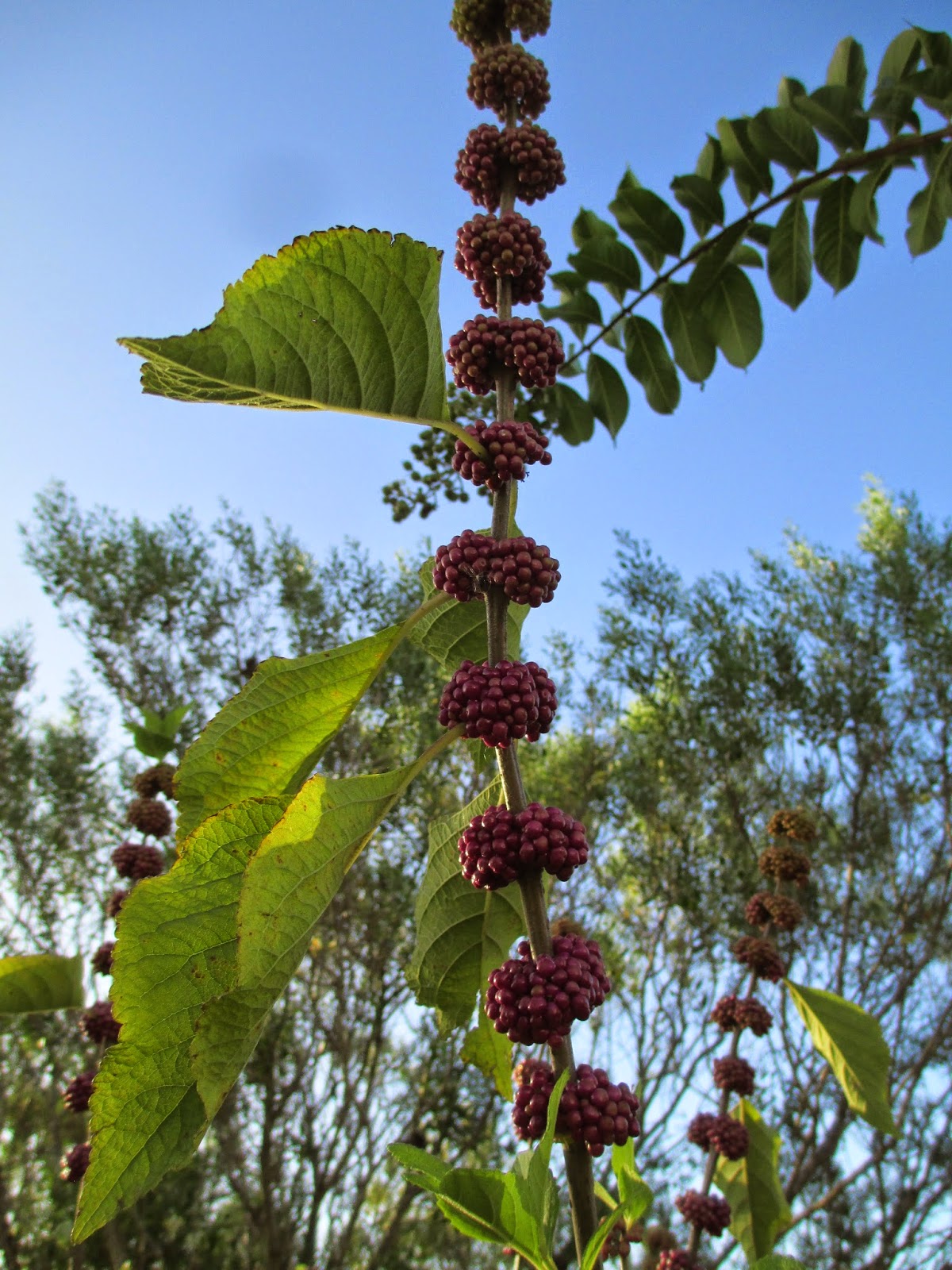
beautyberry

One of the most important aspects of gardening to me
is to provide food, shelter and nesting areas for wildlife.
Many flowers, bushes and trees do just that.
Hummingbirds and butterflies often enjoy nectar from blossoms
on buckeye trees, swamp hibiscus and coral honeysuckle.
This beautyberry is an example of a bush that feeds birds
during the colder part of the year.


Joe Pye weed
Nurturing pollinators ensures that our crops continue to produce.
Butterflies, bees, wasps and birds all aid our food system
by being part of the pollination cycle.
Without these critters, we would be in dire straits.
It just makes sense to support their population.
Joe Pye weed is one of the most visited plants
in the butterfly bed.


milkweed
Some insects are dependent on particular plants,
such as the monarch butterfly.
The native milkweed is the only plant
on which they will deposit their eggs.
The eggs hatch, the caterpillar eats the egg and then begins eating the plant.
In a couple of weeks, it finds a safe spot to form a chrysalis,
where it remains for about 2 weeks,
until the transformation is complete.
What an amazing metamorphosis to witness.


Our class took place at the Maiden library,
where the Advanced Gardener Series also takes place.
This sweet demonstration garden is maintained
by volunteers.


One of the volunteers was in our class,
and explained that she had cut back this gorgeous hydrangea in the spring.
As you can see, it is nearing the top of the window.


You almost can't count the number of blooms!
No doubt, earlier in the year, it must have been a riot of color!
Even though it's no longer a showstopper,
it is still fostering wildlife.

gardenia


I'm not sure what this beauty is,
but it would fit right into my blue garden!
Being able to extend my knowledge about gardening
is such a blessing.
The best part is sharing that experience with others
who are just as passionate about it as you are.

In the spring, I will be looking for more natives to add to the garden.
Thoughts have even crossed my mind
about starting a native nursery,
to aid those who are also interested in encouraging indigenous species.
Who knows?
Anything is possible...


Here's a great resource 
for Native Plants in North Carolina.


Tuesday, October 11, 2016

The Maple Hill Hop 154


Maple Hill Hop


Welcome to 
The Maple Hill Hop.
This is a hop for folks who love the outdoors.
Feel free to post about anything that's going on
OUTSIDE
in your neck of the woods,
no matter the season.
(Please share only outdoor posts.)
*Grab the button above to link back to Maple Hill 101.*

On Saturday,
there was a Master Gardener's Sale 
on native and Florida-friendly plants.
This event occurs twice a year
and much of our garden is composed
of plants from this venue. 


It was a beautiful morning
with abundant sunshine and smiling treasure-seekers.


This display of tiger lily caught my eye.
It's a fall bloomer, so it happily soaked up the sunshine
and strutted its stuff.


The range of colors, textures and shapes was astounding.
Whether one was looking for succulents, flowers or butterfly attractors,
the choices were plentiful.


red penta


crossandra


There were quite a few specimens that were new to me.
The flowers of this beauty were enchanting.


And would you look at the color on this gorgeous blossom?
Simply striking!


For only a few dollars per pot,
there were bargains to be had.
It would be easy to spice up your garden
for very little money.


Wagons at the ready to be loaded up 
and delivered to waiting vehicles.


The tiger lilies proved to be too tempting,
so I brought home two.
One will be given to a friend and the other is for my garden.
I also bought a lemon balm (for the bees)
and found a butterfly vine that was given to Faye & Lynn.


The tiger lily has a seed pod that's just loaded!
I see more of these in our future!


That's what we've been up to her in Central Florida.
What's going on outside where you live?
HOP to it!


Friday, August 19, 2016

Plant Profile-Porterweed


Porterweed is a Florida-friendly plant
that thrives in our Zone 9 climate.
(This perennial grows in zones 9-11).
Most of the plants in this group
are drought-tolerant, require no extra fertilizing,
and don't mind our often hot and humid conditions.


This plant was a gift from a neighbor.
The same neighbor who has that amazing banana tree
we featured a while back.


It started out as a spindly seedling,


and has flourished into a thick, bloom-filled bush.
It stands over 6 feet tall now.
We have it planted on the north side of the house,
in the small garden near the front door.
It gets partial sun during the afternoon
and protection from the wind since it grows against the wall.


The blossoms last from early spring into the cooler fall weather.
All types of pollinators visit daily, 
including various types of bees, butterflies and moths.
It's so amusing to watch the bumblebees as they weigh down the delicate branches,
flitting from flower to flower,
drinking in all that goodness.
Porterweed serves as the host plant for the tropical buckeye caterpillar,
as well as a nectar source for several types of butterflies and the hummingbird moth.


Porterweed readily self sows,
so you'll always have plenty to start elsewhere
or gift to friends.
Cuttings can also be started without much effort.
It is as easy to grow as they come,
and will fill your garden with beautiful blue blossoms.
It can be used as a ground cover,
which would make a stunning floral carpet!

 Have a bloomin' good weekend!


FGF LogoV2


Friday, June 24, 2016

Plant Profile-Tropical Sage


Welcome back to our 
 June series on native plants.
Each Friday, we have profiled a plant
that thrives in our area (zone 9b). 

We conclude our series with 
Tropical Salvia.


This beautiful perennial is native to the Southeastern United States,
and can be found in zones 7-11. 
Its moderate growth habits allow it to be placed
almost anywhere in the garden.
With heights only reaching 2-3 feet tall,
it would be perfect for a tiered effect, 
in front of taller bushes and framed in front 
by low-growing annuals or ground covers.


Although we feature the red variety in our garden,
this beauty also comes in shades of pink and white.
For most zones, the blooming takes place from spring through summer,
but warmer zones can expect blossoms throughout the fall as well.


Native salvia is a boon to the gardener determined to attract
butterflies, wasps, bees and hummingbirds.
The vibrant red blooms signal to pollinators
that there is a steady source of nectar to be found here.


With an easy-growing attitude,
salvia will do well in either part or full sun
and is highly drought tolerant.
In fact, this heat lover will thrive when other plants are fading 
from soaring summer temperatures and oppressive humidity.
Ideal plant spacing is 1 to 2 feet apart,
as powdery mildew can take hold if planted closer.


This low-maintenance garden gem readily self-seeds,
but seeds are easily collected by sliding a hand down the stem for direct sowing
With so many wonderful attributes,
why wouldn't a gardener want to add this alluring native
to a carefree landscape?

It pays to go native!

Other posts in this series:

 Blanketflower
Coral Bean
Beautyberry


Friday, June 17, 2016

Plant Profile-Beautyberry


Today we continue our 
 June series on native plants.
Each Friday, we will profile a plant
that thrives in our area (zone 9b).

Today's chosen native is 
beautyberry.


Beautyberry is an exquisite example of
 how spectacular the native garden can be.
This head-turner is an asset to any naturalized landscape.
Although it is native to Florida,
it can be grown in zones 7 through 11.


This rather unpretentious slow grower
will soon treat the gardener to quite a show. 
The soft, light green leaves 
resemble foliage of the mint plant.


The berries begin as pea-green clusters
assembled every few inches on the stem.
Then the dramatic change takes place.


Over a few weeks' time,
the berries transform into marvelous, magenta gems.
From spring into the early fall months,
this charmer will take center stage.
Many species of birds, including mockingbirds, savor the fruit.


This was one of the first natives we added to our 
Florida-friendly garden.
Its low maintenance and drought tolerance
makes it one of the best choices for newbie gardeners.
Pest problems are nearly non-existent.


Beautyberry gives so much
and requires so little.
I hope you'll consider adding it to your garden bed.


It pays to go native!

Our Simple Homestead Blog Hop


Homestead Blog Hop will take place every Wednesday featuring real food recipes, natural health remedies, DIY, crafts, Gardening Tips, and more...


Other plants in this series:

Blanketflower
Coral Bean