Showing posts with label backyard farming connection hop. Show all posts

Friday, August 22, 2014

Planting Pineapple


One of the easiest fruits to grow here in Central Florida
is pineapple.
The flavor of these homegrown beauties is unlike anything
you'll find in a can at the grocery store.
I've grown these myself, so you know it has to be easy.


This is a pineapple patch at Faye & Lynn's homestead.
They use the metal trash cans to cover the plant when it gets near pickin' time,
so that the raccoons don't get to it first.


Here is Lynn's method of assuring a healthy, productive plant.
The top of the pineapple is saved.
It can be dried for a couple of days in the shade outside,
but it's not necessary.


Lynn uses  needle nosed pliers to remove the bottom-most leaves
from the crown of the plant.
Gloves help protect hands from thorny leaves.


You can see the ones closest to the neck are the most dried out.


By just removing a small handful of leaves,
the pineapple has a better chance at becoming productive.


The small brown patch you see here is the beginning of roots.
By eliminating the outer leaves, the roots have more opportunity to attach to the soil
and thus, start growing.


See how many more roots there are now?
Lynn whittles down until a small knob is formed.
That's what gets planted.
Pineapple plants like full sun and are surprisingly drought-tolerant.
Give them space, 
because many times, they will quadruple in size.
They can also be grown in containers.


This tropical wonder loves the heat!
The plant produces one fruit at a time,
but will continue to produce,
treating the gardener to sweet, juicy pineapple over and over.


When the base of the fruit turns from green to mostly brownish-orange,
it's ready to harvest.
Simply twist at the base and it will come right off.
You're set to enjoy one of the most delectable and refreshing tidbits
that ever came across your plate.
Enjoy!



barnhopimage


http://www.anoregoncottage.com/wp-content/uploads/2013/03/jtgpfinal.png


Back to the Basics


Friday, July 11, 2014

Colorful Crape Myrtle


Crape Myrtles are exploding with color here in Central Florida right now.


Everywhere we travel around town,
a sea of subtle hues greet us.
These lovely trees dot the landscape from
South Florida all the way up to northern Virgina,
with new varieties being created to withstand more northern conditions.
It seems everyone loves this fantastic bloomer.

In a spectrum of color ranging from crisp white
to deep, dark magenta blooms,
any homeowner can find the perfect shade to add to the garden.


Enjoying full sun, these beauties will keep the flowers coming
through the summer and even into the fall months.


Included in the list of Florida-friendly plants,
we have several growing 
in our low-maintenance backyard garden.
Bees and butterflies alike enjoy them almost year-round.


There are a few volunteers in our back bed that need transplanting.
I just love a plant that keeps on giving!


Crape Myrtles can be grown as a shrub,
or if well-pruned, make graceful trees,
allowing the handsome bark to be featured.

With moderate watering needed,
these trees are as easy to care for,
as they are to behold.


We were happy to spy them on vacation in North Carolina,
so we know that when we make our move,
we'll be able to grow them on our property there.
They add a welcoming feeling to any homestead.


Crape Myrtles are one of the best things 
about living in the South.


Here's an informative article about this Southern staple.


barnhopimage


Backyard Farming Connection


http://www.anoregoncottage.com/wp-content/uploads/2013/03/jtgpfinal.png


Monday, June 16, 2014

Farm School Epilogue


Our year at Farm School has come to an end.
The learning will continue, no doubt,
and it's been an amazing process.


I can't thank Faye and Lynn enough for allowing me
to take this crash course in farming.
God really hooked me up.
We were a perfect match from day one.
Being able to share our ventures with those who read these posts
is simply icing on the cake.
Enjoy this look back and let us know what you think.


It all starts with this.
We learned how to make rich, fertile soil.
The health of the soil is really key to any type of planting.
Beginning with an airy mixture allows seeds to get what they need to germinate 
and nurtures the crops once they get going.
With just a few amendments, dirt becomes black gold.


We've worked on growing everything from 
arrugula to tomatoes, 
and featured Lynn's unique style of planting.
Attention to detail is of utmost importance here
and each successful crop shows just that.


Transplanting tips as well as proper fertilization
help to ensure that plants stay healthy and become prolific producers.


A host of Lynnventions stirred my curiosity
and fostered the bent toward thinking outside the box.
Frugality is valued here,
and bodes well with the tasks at hand.


We've been able to enjoy some of the best produce we've ever eaten,
simply because these gardeners work nonstop to make it so.
Being able to help out once a week was a blessing for me,
but Faye and Lynn work at this every day,
sometimes 24 hours a day.
It really helped me appreciate what farmers go through
to bring us the food we eat.


This experience has forever changed me.
With Lynn's guidance,
I have become a confident gardener.
I am more willing to try new things, new ways
and know that if it doesn't work out the way I expect,
there's always another chance to get it right.
Life lessons, these.


Moving forward with our plans to buy acreage,
I have a better vision of what I wish to create.
We may not have a 4,000 square foot container garden,
but rest assured that our property will be used to feed ourselves and others.
Faye and Lynn's endeavors drove home the perspective
that being able to feed others is  
a huge deal.


Witnessing the miracle of farming has been such a gift.
Placing these tiny seeds in some dirt 
and growing food that is delicious, nutritious
and keeps us strong and healthy
just boggles my mind.
With every germinated crop comes another chance
to give thanks and savor the moment.


Knowing that we can be a part of something
that makes the world better is very comforting.
It's been an amazing adventure,
and I am beyond grateful for having had the experience.


I really hope that you've found something valuable 
in the Farm School posts.
It is my intention to keep the good stuff moving.
Please feel free to peruse all of the Farm School posts
found just under our header.

We'll continue to post new things happening on The Hill.
After all, there is plenty more to soak up
and I plan to get 
every last drop.
Enjoy!

http://www.anoregoncottage.com/wp-content/uploads/2013/03/jtgpfinal.png

Backyard Farming Connection


Monday, June 2, 2014

Farm School Spring Series Week Eleven


The Spring season of Farm School is just about over,
and with it, the garden is winding down for summer.

It probably seems strange to folks further north,
as their gardens are just gearing up,
but in the high heat and humidity,
there's not much that grows readily in Central Florida.


 Case in point, Tomato Town has left Dodge.
The Celebrity variety that were being grown here
were not up to snuff for the farmer's market
so they were pulled out.


Unfortunately, the Sweet Millions are also having their share of problems.


 Although we've enjoyed a few harvests from these crops,
there are only a couple of handfuls left for noshing
that haven't been affected by this splitting.


 There are more on the way though!
So far, these transplants look healthy and strong.


Okra is one of the easiest crops to grow,
even in the heat of the summer.
We also checked on the Swiss Chard 
that had been transplanted a couple of weeks ago.
So far, so good.


Worms have been a problem in the collards.
Thankfully, this crop is on its way out anyway.


 Even the newly sown lettuce is being infested.
As Lynn & Faye grow everything pesticide-free,
these buggers are removed by hand-picking.


The okra is basking in the summer-like conditions.
There is an abundance of this growing.
Some is for pickling and some is to sell fresh.


Beautiful flowers and it tastes good too.
What more could you ask?


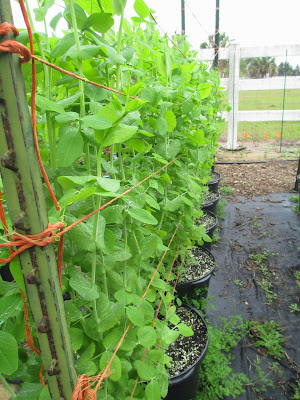
 Another crop that is looking strong is the black-eyed peas.


 I couldn't believe it when I saw not only how many more pods were on each plant,


 but the size of the pods themselves must have tripled since last week.


 I can't wait to sample fresh black-eyed peas for the first time.
I've only had them dried.
It'll be fun to shell them and see what kind of flavor they have.


The sugar snap peas are surprising us with lots of blooms and pods.
We had almost given up on getting another crop out of this batch.
They prefer cooler temperatures than what we've been experiencing in the last month.


What a treat if we get even one harvest in June!


 These seed pods are from the Cat's Claw plant,
which Lynn tells me is an invasive species.
Aren't they just amazing?!


Today we worked on sowing more of the 
heat-tolerant lettuce varieties.
Cell packs are filled with Lynn's loose soil mix.


 The soil is leveled out using a flat-edged knife,
then the cell pack is lifted and carefully dropped to settle the soil.


We use tweezers to meticulously place one seed per cell.
 We sowed the Red Sails variety,


 as well as the New Red Fire type.
Cell packs are then placed on trays,
then misted immediately to promote germination.
Covers remain on in the evening until the seedlings pop up.
We also cover them during rainstorms, so as not to disturb the delicate seeds.


 A couple of joyous discoveries were made earlier in the week.
These are Mockingbird eggs.
Faye had found two in the nest,
but when we checked, there were four!
Aren't they darling?


In another tree, these baby cardinals were resting
after an exhausting morning of eating.
Some life, huh?
They sure look cramped in there, don't they?


 Here's some of the good stuff I brought home.
These banana peppers get roasted and added to just about everything.


The cherry tomatoes are so good all by themselves,
but I roast some of these too and add them to tacos,
pasta, rice and beans and whatever else happens to be on the menu.
They really live up to the name Sweet Millions.


Hope you found something useful today at Farm School.

If you'd like to read about the year-long adventure,
check out the tabs under our header!
It starts here.
Enjoy!