Showing posts with label garden tuesday. Show all posts

Thursday, July 28, 2016

Thrifty Thursday-Drying Herbs


One weekend at Farm School,
we were transplanting lavender sprigs.
In that process, we had to trim the branches
in order to plant them in their new pots.
Not wanting all of that lovely aroma go to waste,
I brought some home to dry.


Nothing fancy here.
No dehydrator, not even a microwave.
Leaves were laid on some newsprint,
spread out, and left alone.

Several layers were completed
and they nestled there in an old open, wooden crate.
Keeping them covered with another piece of paper
will keep the dust away.
You could use any box or other container,
as long as it is out of direct sunlight.


A week or two is all it takes.
Crumbling the leaves creates quite a treat for the senses.


Pretty much every herb works this way.
Just check them every couple of days to see how they are coming along.


I plan to make sachets with the lavender.
Sprinkling a bit on the carpet before vacuuming is another use.
However you decide to use your dried herbs,
no complicated equipment is necessary.
Just a little time and effort
will reward you with a simple pleasure.

What's your favorite way to dry herbs?


How We Roll Logo


Our Simple Homestead Blog Hop


FGF LogoV2


Friday, June 17, 2016

Plant Profile-Beautyberry


Today we continue our 
 June series on native plants.
Each Friday, we will profile a plant
that thrives in our area (zone 9b).

Today's chosen native is 
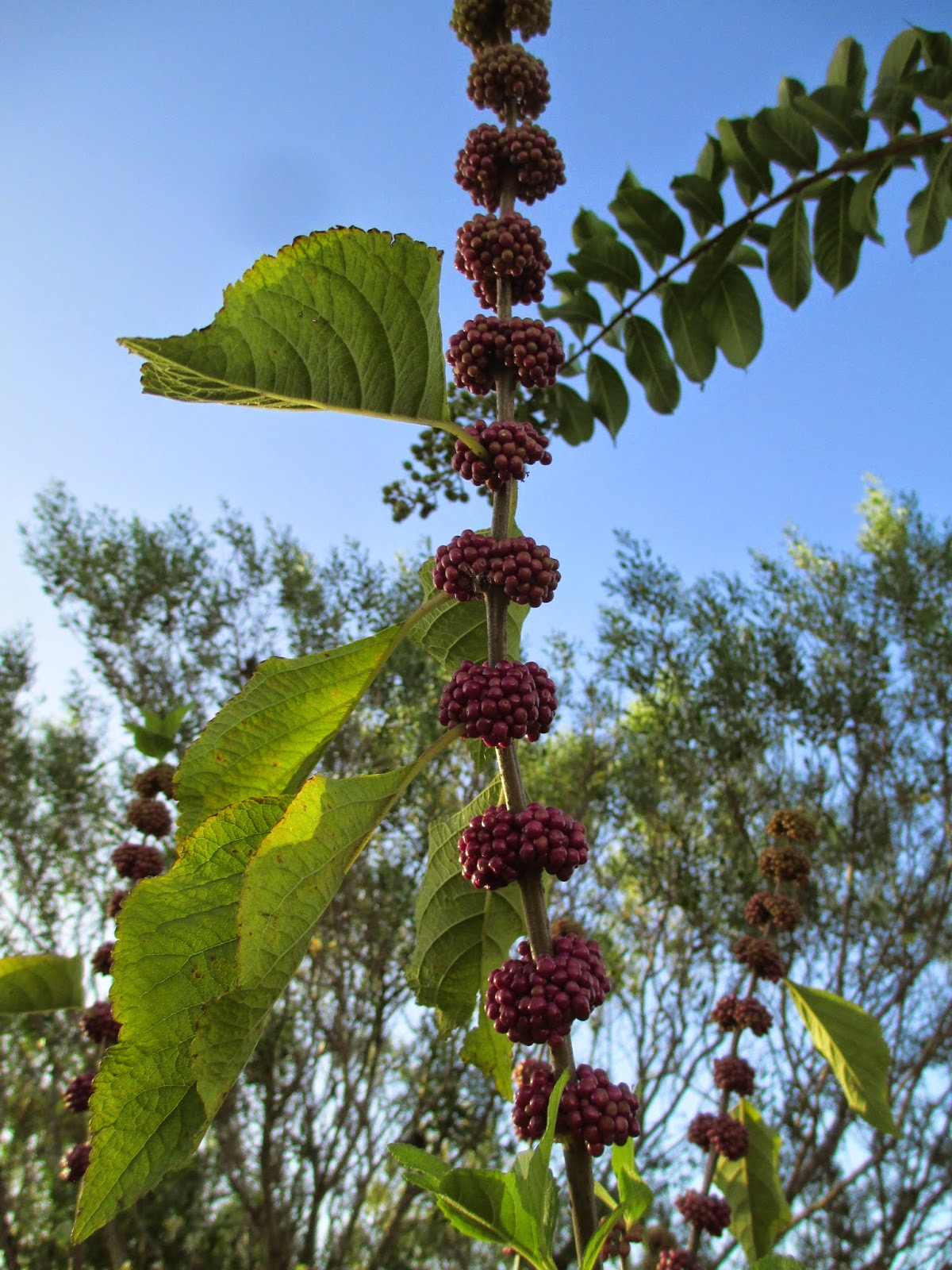
beautyberry.


Beautyberry is an exquisite example of
 how spectacular the native garden can be.
This head-turner is an asset to any naturalized landscape.
Although it is native to Florida,
it can be grown in zones 7 through 11.


This rather unpretentious slow grower
will soon treat the gardener to quite a show. 
The soft, light green leaves 
resemble foliage of the mint plant.


The berries begin as pea-green clusters
assembled every few inches on the stem.
Then the dramatic change takes place.


Over a few weeks' time,
the berries transform into marvelous, magenta gems.
From spring into the early fall months,
this charmer will take center stage.
Many species of birds, including mockingbirds, savor the fruit.


This was one of the first natives we added to our 
Florida-friendly garden.
Its low maintenance and drought tolerance
makes it one of the best choices for newbie gardeners.
Pest problems are nearly non-existent.


Beautyberry gives so much
and requires so little.
I hope you'll consider adding it to your garden bed.


It pays to go native!

Our Simple Homestead Blog Hop


Homestead Blog Hop will take place every Wednesday featuring real food recipes, natural health remedies, DIY, crafts, Gardening Tips, and more...


Other plants in this series:

Blanketflower
Coral Bean

Friday, June 3, 2016

Plant Profile-Blanketflower


Today we begin a month-long series
on native plants.
Every Friday, we'll feature a different plant
that thrives in our Central Florida climate.

Today we begin the series with 
blanketflower.


Blanketflower is a sun-loving annual
that grows well in zones 3-11.
Its brilliant red, orange and yellow blooms
are reminiscent of a beautiful watercolor masterpiece.
This Florida-friendly native is drought tolerant,
low maintenance, and easily started by planting the dried seeds in the spring garden.
Through spring, summer and even into the fall,
this stunner will grace your garden with a muted pop of elegance.


This versatile plant can be grown as a ground cover, 
(hence the term, blanketflower),
or used in conjunction with other plants,
and stand upright up to 3 feet tall.
It tends to spread,
so be sure to give it lots of room to strut its stuff.
The ability to tolerate dry conditions
allows it to thrive during long periods
when rain is scarce.
It loves full sun and especially appreciates
well-draining soil.
It is often found in coastal regions,
and is considered highly salt tolerant.


Another wonderful feature of this particular annual,
is that it attracts a multitude of pollinators
including bees, butterflies and wasps,
while being deer resistant.
Being more conscientious about planting for pollinators
is a personal goal.
We strive to support these crucial creatures
in every way we can.

Hopefully, you'll be able to add this lovely bloom
to your garden repertoire.
You'll be glad you did!

It pays to go native!


FGF LogoV2


Our Simple Homestead Blog Hop


Friday, May 6, 2016

New Home for the Birds


In 2011, this Florida maple was brought home
from one of the Master Gardener plant sale events.
It was probably knee-high.
It now stands over 6 feet tall.
It needed a new home,
as it was sharing space with an avocado tree that has taken off!
Bad gardener, planting 2 big trees so close to each other.
How was I to know that the lil' avocado pit I sprouted
would grow up to be a colossal tree!


Our yard faces the neighbors behind us
with no privacy whatsoever.  
In Tuesday's post, I mentioned that I wanted to add the maple here in the back bed.
With the blessing of a good rainstorm on Wednesday and cooler temperatures yesterday,
it seemed like the perfect day to tackle this project.


There's a spot in the fern bed all picked out.
I placed the shovel to mark where it should go.


The rootball wasn't too big,
so I had no trouble digging it out by myself.


I doubt the neighbors will mind the extra privacy.
(Click on photo to enlarge.)


It works for me,
and I think the birds will be happy 
to have another place to call home.
Lots of water over the next couple of weeks
should help to establish it in its new location.
Maybe we'll even be blessed with more rain.
It's spring, so everything wants to grow,
and I'm hoping it will fill in the spot rather quickly.


Now the avocado tree can get as big as it wants!
Mother Nature never ceases to astound me.

Enjoy your weekend, y'all!


Our Simple Homestead Blog Hop

FGF LogoV2


Thursday, April 28, 2016

Seed Bombs


Earth Day was a great excuse for me to try something new.
Seed Bombs!
The idea originally was to beautify abandoned lots in the urban landscape
by anonymously tossing these into vacant lots.
The rain helps them to randomly bloom.
Of course, they can be used elsewhere,
but the idea is the same.
Fashion the bombs and let Mother Nature work Her magic.
It sounded too fun to pass up,
so we made ourselves some.


Here's all you need:
seeds
water
potting soil
compost
clay


Our soil mix already contained compost,
so we didn't need to add it separately.
It was also fairly moist, so we didn't need to add water.


The air-dry clay can be found almost anywhere.
It's a bit soft to the touch right out of the container.


Golfball-sized spheres were formed and placed aside.
It was easy to do a dozen at a time.
The container of clay we bought
made a little over 50 seed bombs.


An indentation was made in the center of the clay.


Time for the seeds!
You can use any type of seed,
although easily-germinating seeds or wildflowers do best.
We used 4 types:  
beach sunflower, cosmos, marigold and zinnia.


A few seeds were added to the soil mixture.


The open end was closed.


The bombs were left outside to dry during the day.
It took about 2 days for them to become fully dried out.


I ended up marking the bombs 
with the first letter of the seed type,
in case they got separated from their containers.
This was a fun project 
and I can't wait to see them come up!
Magic, I tell ya!


If you don't want to make your own seed bombs,
you can order some here.


Our Simple Homestead Blog Hop


FGF LogoV2


Motivation Monday In-Linkz