Sweet potatoes are one of the easiest crops to grow. Just look at last year's bed overflowing with vines. They are heat lovers and require very little care, yet they produce not only edible leaves, but one of the tastiest treats ever put on a plate. These spuds are high in vitamin A, contain B6, Vitamin C and a host of minerals as well as fiber and absolutely no fat. They are highly digestible, easy to acquire and will do a great job of filling your belly. Another asset this veg has is that it stores well for months, so you can always have them on hand.
I discovered this recipe on Downshiftology, one of my favorite cooking vlogs. Lisa calls it sweet potato toast and uses a mandolin to slice it, but a standard chef's knife does just fine. It's such a simple idea and takes even less time than sweet potato fries. In a mere 15 minutes, you can be enjoying these sweet treats. Sweet Potato Planks 1 large sweet potato (cut into thick planks) olive oil salt cinnamon Other options: honey maple syrup
Place planks on parchment-lined cookie sheet. Add seasonings, being sure to turn planks over to distribute the seasonings. Place in a 400 degree oven for 10 minutes, then turn over and bake for another 5-10 minutes. Enjoy!
In an effort to find a solution to the dermatitis plaguing my hands, I have decided to try going grain-free for a month and see if it makes any difference. I have already changed out all of my personal care products and eliminated all Sulfates from anything that touches my skin. I'm also excluding nightshades and almost all dairy, in an effort to promote healing. These are all foods that can become problematic, so I thought I would give it a go. Truth be told, the first 2 days without grains was pretty tough. Bread is such a comfort food and I miss my toast and jam something fierce. But, the only way I'll know if it is a factor, is if I eliminate it and then reintroduce these things one at a time. Allergy testing was done a few months ago, but are not reliable. Sensitivities do not show up on those tests, only true allergies. So, here we go again, trying to find our own answers.
This recipe gives me the comfort of carbs without any grain at all. A stash will be kept in the fridge to be eaten a couple of times a week. Other changes I've made are smoothies for breakfast, and substituting celery, carrots and kale to be eaten with hummus, tuna salad or egg salad. It's a challenge to find satisfying foods, since I have a fondness for sandwiches, pasta and oatmeal. But after all, it's only for a month and it is allowing me to discover new ways to add even more veg to my diet. These pancakes are great for anyone who needs allergy-friendly food, and I imagine that squash or pumpkin could be subbed out for the sweet taters. Add some local honey and your favorite berries on top, and you're talking yummalicious!
Sweet Potato Pancakes 1/2 C mashed sweet potato 3 T almond flour 1/2 t baking powder 1/4 t cinnamon 2 eggs 1 t butter (optional) Cook sweet potato until soft, then mash in a bowl. Beat eggs, then add remaining ingredients (except butter). Whisk until smooth. In a skillet, spray with cooking oil or add butter, then add 1/3 C mixture over medium heat. (I added coconut oil instead of butter to keep it vegan). Cook 3 minutes per side, until each side is a golden brown. Add favorite toppings and enjoy! Serves 2-4.
Welcome to our Summer Series, Seed to Table. Every Friday, we'll explore a different crop that you can grow in your own garden. Whether you're in mid-harvest, already looking ahead to your fall garden, or just thinking about growing your own, we hope this series inspires you. We'll begin with planting from seed or seedling, and end up with a scratch recipe.
~~~~~~~~~~~~ We begin the series with sweet potatoes. It's one of the only crops that will thrive in our summer heat.
It starts here. All that is required is to place a sweet potato into water until sprouts form at the bottom. It's called a sweet potato slip. We used small nails to prop the spud out of the water, but toothpicks, chopsticks, or wire will do just as well.
After a few days, white roots will emerge from the bottom. A few more days will pass before you see the leaves start to sprout right out of the top. It doesn't get much easier than that, folks.
When the leaves are abundant, transplant it to the garden. It will take off and sprawl, so give it space or use a trellis to support the vine.
The light purple (almost pink) blooms are an added bonus! When the leaves begin to turn yellow, they are ready for harvest. Dig them up, compost the leaves and cure the potatoes for about 10 days. This simply means leaving them out to dry in a warm place (but not in direct sunlight). This enables them to develop their sweetness.
Eating a variety of colors is a sure way to add health and vitality to your life. Sweet potatoes are loaded with calcium, potassium and the A and C vitamins. Something so delicious and good for you too? Who could ask for more.
We hope you'll add this easy-to-grow crop to your garden. Join us each Friday for our Summer Series- Seed to Table.
Here's one way we enjoy these sweet delights:
Sweet Potato Fries
3 sweet potatoes, cut into wedges olive oil salt cinnamon
Lay the potatoes on a parchment-lined cookie sheet. Add oil and seasonings to lightly coat. Bake at 425 degrees for 12 minutes, turn and continue baking 8-10 minutes. Enjoy! Quick Announcement! The premier issue of Modern Farmstead magazine is out today. This is the brainchild of my friend, Staci, over at Life at Cobble Hill Farm. I hope you enjoy my article on simplifying, as well as the contributions of some talented bloggers. You can find it here.
so I thought I'd whip up a batch of sweet potato soup. The weather has been cooperating just enough, so that a bowl of soup really hits the spot.
A handful of ingredients makes this dish a snap to put together in less than 30 minutes. Sauteing the onions really brings out their sweetness. If you don't care for sweet potatoes, this method for soup making can be used with white potatoes, butternut squash, or carrots, or any combination of your favorite veg. Sweet Potato Soup 1/2 yellow onion, diced olive oil 3 sweet potatoes, chopped salt cinnamon (optional) water or bone broth
In a medium pot, sautee onion in olive oil until translucent (5-7 minutes). Add sweet potatoes and cook until almost tender (8 minutes). Add seasonings and fill pot 3/4 full with water or a combination of water and bone broth. Bring to the boil, then turn down to low heat. Simmer with lid on about 10 minutes. Use an immersion blender or food processor to blend until smooth. Enjoy!
Growing sweet potatoes is pretty standard around these parts. They've been a staple in my garden for a few years now, and this year is no different. It was sensational to learn that not only is the sweet potato the state veg of North Carolina, but we are also the number one producer of these sweet spuds. It somehow feels as if I was preparing for this journey back in Florida, having fairly good success with growing them as a beginning gardener.
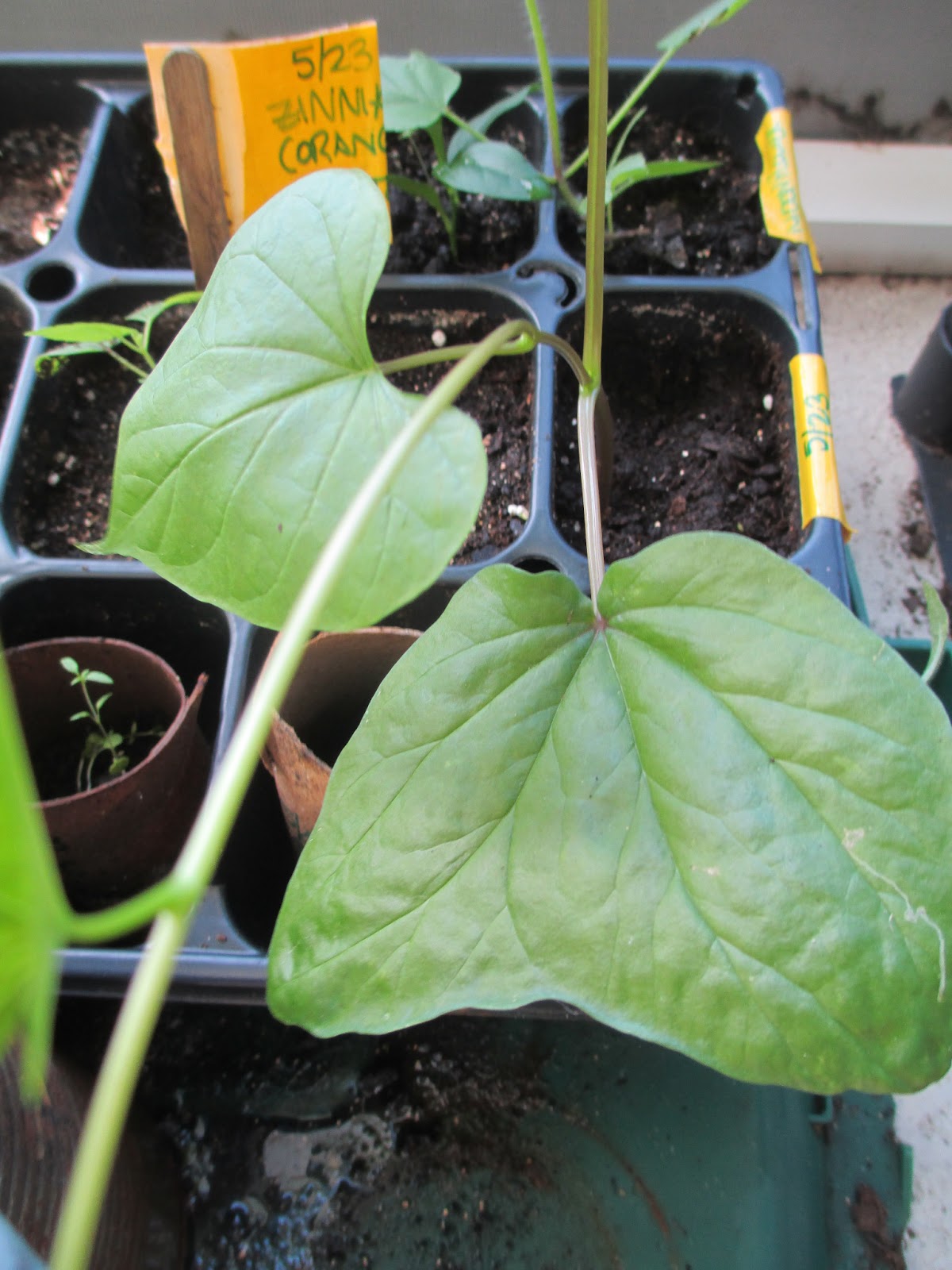
Sweet potatoes are grown from slips, which are vine-like plants grown directly from the spud itself. They can be purchased, but this year we decided to venture out and grow our own. It started right here, with organic sweet potatoes bought at the grocery store. The three perfect specimens I picked out of the bin were brought home and the bottom half was submerged in water. Empty cans were used here, but you could also use plastic or paper cups, or glass jars.
After a few days, the roots will begin to sprout from the bottom (as shown in the previous picture), and shoots will start to grow out of the top. Once I placed the cans on the windowsill of our makeshift greenhouse, they really started taking off, enjoying the morning sunshine.
When the shoots get about 6 inches long, they can be transferred to another container filled with water. They will keep like that for as long as you need, continuing to drink up the water until you are ready to plant them.
The planting box was readied.
Big K and I decided to make this growing bin specifically for the sweet potatoes,
and the vines will have the arches to climb.
Here's how we easily constructed this container out of pallets.
There were enough healthy slips to use,
and looking at the root system,
they were more than ready to be transferred and given a lot more room to grow.
Into the box went a layer of straw
(mostly to contain the soil),
then some good potting soil to which I added perlite
to ensure good drainage.
Another addition was some worm castings from our worm bin,
along with a few new residents.
I've been introducing worms and castings to most everything planted recently.
I figure it can't hurt.
Look at those healthy roots!
The slips were planted and nestled in the box.
Sweet potatoes are one of the easiest crops to grow,
requiring very little from the gardener.
With regular watering and maybe some fertilizer or compost added
once in a while,
they will begin their ascent up the trellis.
Not only is the gardener gifted with a wonderful taste treat,
but the climbing vines will produce a morning-glory type purple flower
for enjoying until harvest time.
Incidentally, the leaves of this crop are edible.
When I was digging in the soil pile, I ran across these little spongy things. These are skink eggs. I was sure to replace them so that they can join their siblings. There is always something new to learn in nature.
The first day of summer is not until Friday, but you wouldn't know it by the temperatures and afternoon storms with which we've been frequented. Here's what's goin' on at Maple Hill.
We spent some time with friends a block over, and their crape myrtle trees are bloomin' big time!
While my farmer friends Faye and Lynn were away,
they asked me to water their cherry tomatoes.
Unlike full-sized tomatoes,
these beauties can be grown all summer long.
These luscious pearls are a tasty treat. We were allowed to snag a few for our efforts.
Back at home, it was a great time for seed starting.
Yogurt cups and toilet paper rolls were readied for the seed.
As most of our veggies are done for the summer,
we will be planting a variety of flowers
that don't mind the heat and humidity.
Love reusing these containers I found in someone's recycle bin.
Thanks, neighbor!
It only took a few days to get germination.
Here's one of the moonflower plants grown from seed. These are fragrant and bloom in the evening.
The one exception to our summer slow-down is sweet potatoes.
I'm starting a slip with a white sweet potato. It was the only organic sweet potato I could find at the market.
I also started some basil and parsley. Some of the parsley will be used to host caterpillars.
The beautyberry is producing tons of berries for the birds.
These green grape-like clusters will turn a brilliant magenta.
It's been one of our goals to provide more food for wildlife.
This cutie was happy to stay still long enough for its close up.
The gloriosa daisy has come back to spend some time with us.
What a blessing. A few of the first sunflowers are waking up.
Last year there was an absence of these cheery blooms.
Somehow, it doesn't feel like summer without them.
The rosemary and sweet potato vine seem to be content sharing space.
Remember the caterpillars that were found on the parsley plants
at Farm School this week?
We decided to rescue them from certain demise.
After all,
Faye & Lynn do need to have some parsley to sell.
We happily brought them home.
We've been having a great time making a home for them.
Several were given to one of my students
who loves the critters and all their magic.
Our past experience has been with Monarchs, which can be seen here.
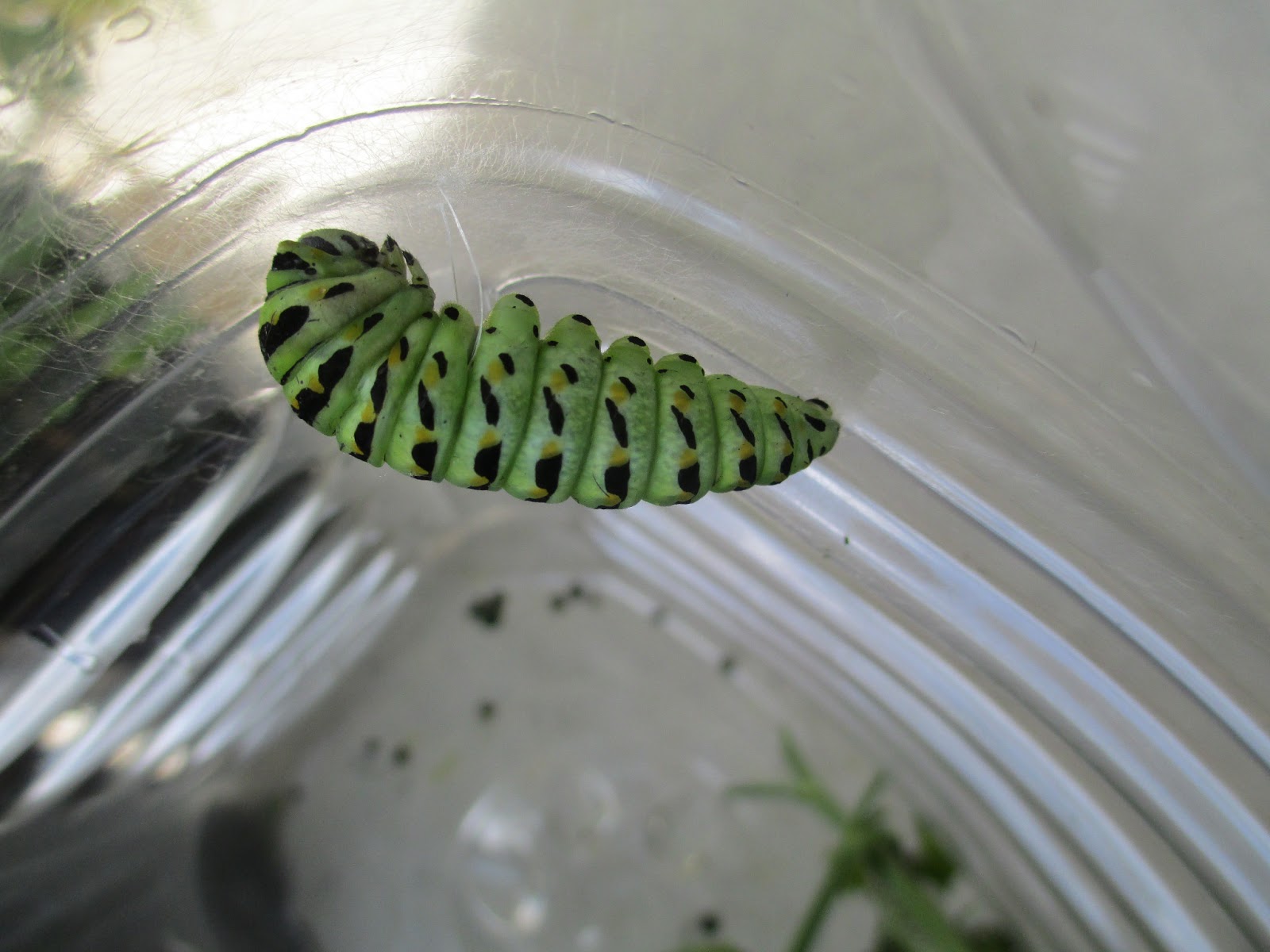
They are similar in color, but have stripes instead of spots.
These are Black Swallowtails, so we are thrilled with the chance
to learn about a new type of critter.
You can see this one starting to attach itself to the netting with silk. It is forming the curved shape, preparing to create the chrysalis.
Another attached itself to the empty lemonade container we provided.
After the chrysalis was formed, it turned this shade of brown.
You can see another cat suspended from the parsley stem. Its chrysalis remains green, to blend in with the plant. This lil' guy affixed itself to the top of our patio roof. It stayed this way for a day. I was able to capture the actual making of the chrysalis. Watch this:
This one must have been quite content to stay put, because it secured itself to the very parsley plant it had been devouring.
They are voracious eaters, which is why Faye and Lynn were happy to part with them in the first place. Works for me...
Hope you have all kinds of fascinating things where you are today!