Showing posts with label row covers. Show all posts

Friday, November 12, 2021

Garden Friday


It's time again for Garden Friday!
We are relishing our autumnal weather,
and were even blessed with a smattering of precipitation.
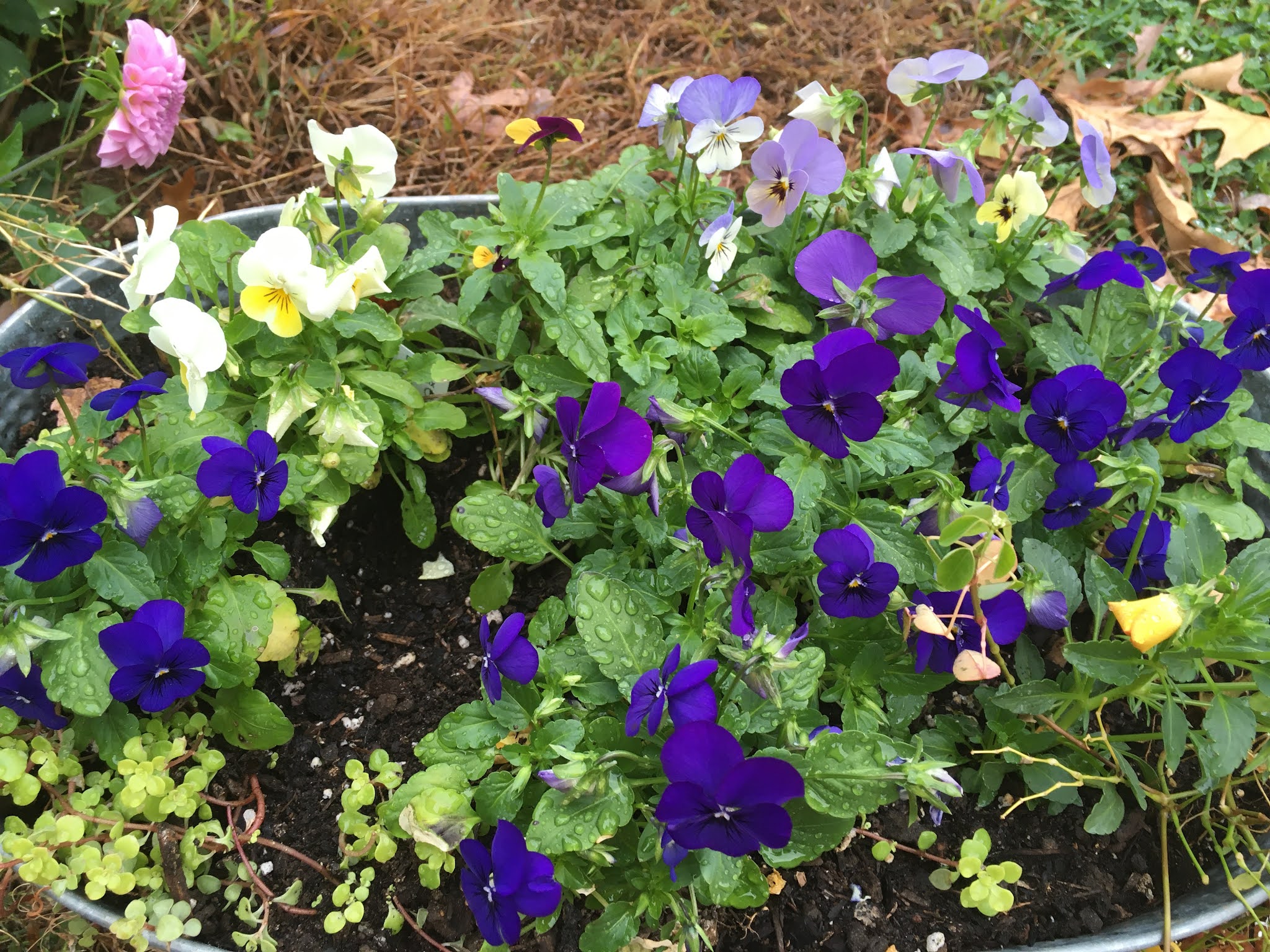
Our pansies are enjoying their time in the rain.

 
The cover crops are filling in 
and will create a warm, cozy blanket for one of our 3X8 beds.

 
The garlic is growing well, especially considering our colder temperatures.
I sowed a few extra cloves from some of last year's garlic,
as we had some bare patches.

 
The cattle panel frames have been placed on some of the beds
for the winter, just in case we need to put row covers on.
These did a great job last year to keep out the cold.

 
The lettuce is still fairly slow growing,
and even the starts that were purchased aren't doing much.
I fertilized them this week with worm compost tea,
so we'll see if it helps them along.

 
I was surprised to find peas growing on the pea vines.
They kind of snuck up on me, 
but I'm so happy they are here.

 
I need to take some time to do a bit more clean up,
like cutting these irises down for the winter.
Once the foliage starts flopping over and turning brown,
it's time to put them to bed.
Some of them will be transplanted to other areas.

 
Some of the lavender didn't do well.
The gap shown here used to be lavender.
It may not be getting enough sun,
as it is planted directly under our crape myrtle.
It will most likely call another place home come spring.
One of its uses is to keep the chicken coop smelling good.

 
Leaves, leaves, leaves!
It's that time again to repopulate my leaf mulch pile,
and we've got plenty of leaves to get started.
Leaf mulch has done a tremendous job
in keeping weeds down in the flower beds.
It also adds nutrients to the soil in the veggie garden.
And best of all, they're free!


These nasturtium seeds are drying inside.
They are sown in the corners of our raised beds,
to attract pollinators to our vegetables,
by providing nectar to those who thrive on it.

 
Just by taking this step,
I am assured another season of these beautiful (and edible) flowers.

 
I have yet to plant the bulbs I was recently gifted.
I should still have some time, as our ground never really freezes.
I hope I didn't just jinx myself!

 
For those who were concerned about Gandalf,
he is doing much better and acting more like himself.
He still has a way to go to fully heal,
but it's heartwarming to see him once again strutting around the coop.
We will be starting a project to keep the chooks better protected.
The dog who injured him has not yet been caught,
but he visits our neighborhood almost daily.

 
Autumn has been delightful thus far,
and we are patting ourselves on the back
for our decision to move here a few years ago.
Once again living with the seasons was a great idea.
 
 
Are you enjoying some seasonal living?
 

Friday, December 4, 2020

Garden Friday


It's Garden Friday
and we are hoping to thaw out from this week's low temperatures!
 With the Winter Solstice still looming,
we've had our share of chilly mornings around here.
Let's see how the garden fared.
 
 
Well, the clover that we use as a ground cover got frosted,
but as soon as the sun was out,
it bounced right back.

 
The beet greens got a bit icy,
but with the roots nestled cozily under ground,
the frost will simply make them sweeter.

 
That's what happened to the kale 
after its close encounter with the frigid conditions.
After sampling some yesterday while picking greens for my salad,
I couldn't believe how much sweeter it was!

 
Under the row covers, I checked to see how the carrots, leek,
lettuce and snap peas were managing.
Turns out, they were just fine and amazingly,
they continue to grow despite what the thermometer reads.

 
The Walla-Walla onions, which are uncovered,
are coming along nicely.
They don't seem to mind the icy temps at all.
We also have red cabbage and parsley growing in this bed.

 
The garlic just keeps on chuggin' along.
The drip irrigation has been disconnected over this last stretch of weather,
but we will monitor the temps and reconnect it when our lows
are back in the mid-to-high thirties.


There should be plenty of garlic for the coming year.
It will be harvested in May of 2021.

 
When working out in the yard this week,
I spied this gorgeous holly shrub,
just loaded with berries.
If that doesn't scream "the holidays",
what does?
I may have to snatch a few to decorate our mantel.

 
Unbelievably, the yarrow has actually had blossoms on it this week.
It doesn't seem fazed in the least by the chill factor.

 
We still have our sweet lil' (free) bush daisy,

 
as well as our salvia blooming.
These are some hearty flowering plants.
 
 
 Yesterday, I began pruning back a lot of dead material
in a couple of the beds.
This work will continue until things are tidied up.
There is still leaf mulching and wood chipping to do as well.
Autumn is a great time to get caught up 
on some foundational chores for the garden.
 
 
And speaking of tidying up,
this was one of three Gator loads of brush and debris
that was hauled off into the woods on one of my jobs.
There is enough left to keep me busy for a few weeks,
and I look forward to the task.
Wintertime can be sad for gardeners,
but it's also the time we need, to plan for future gardens,
stock up on seeds, and give our bodies a bit of rest.

 
As our temperatures have plummeted in recent days,
the chooks' water has been frozen solid when their coop is opened in the mornings.
A gallon-sized jar of warm water easily takes care of that.

Gandalf
 
They've also been getting some warm rice in the morning,
and extra food, which helps them maintain their body heat.
 I will be making a big batch of oatmeal for them,
so that it will be ready for their breakfast each day.
They give us so much,
it's the least we can do. 


Thursday, October 29, 2020

Cattle Panel Row Covers

 
We've used cattle panels for all sorts of garden projects.
On our original site, they were placed as arches
along the east side of the garden
where we grew snap peas, beans and melons.

 
Since moving the garden to our new location,
we've used them to make a storage area, a compost station 
and these frames for our raised beds.
We want the option of covering the beds in the colder season,
and since these are easily constructed, we got to work. 

 
Each frame can be cut to size to fit most any raised bed, 
using a sawzall or heavy-duty wire snips.
The cattle panel used here was simply cut in half,
bent over on itself and placed in the bed.
This actually consists of two 4-foot wide pieces placed side by side.
Depending on the crop,
the panels can be made higher or lower to accommodate the size of the plant.
One of the aspects I like the most about using these panels
is that it is easy to access the bed through the holes in the fencing.
Sowing, harvesting and maintenance are all fairly easy to do,
even for folks with hands larger than mine.

 
Most of our covers are 6 feet in length, so that when bent in half to form the arch,
three feet of space is created. 
That six feet doesn't include the ends,
which were cut so that the bottoms would sink into the soil.
Upon Big K's suggestion, the spiked ends were bent 
so that the frames would tuck in closer to the edge of the bed.


I also cut off the four spikes on the outside corners of the panel.
This allowed me to rest the end of the panel
on the concrete block corners
and left less of a gap between the board and the first crop.
 
 
These panels are solid and rust-resistant,
so I should never have to make them again for these beds.
Each frame took about 15 minutes to construct
and yet, will give us years of service.
They cost a little over $20 a piece and with a small investment,
many of these covers can be fashioned, 
along with a number of other garden projects.


I love the way they turned out.
With colder weather on the way,
it'll be our first foray into creating a greenhouse effect
to see if we can keep our crops going into the new year.
In the spring, it will give us an edge on pest control,
with row covers creating a barrier from harmful snackers.
 
I'd love to know if you try this project!