Tuesday, November 5, 2019

Allergy-Friendly Applesauce Recipe (gf, df, cf, sf)


It's really fall, y'all!
I'm on week FIVE of this 6-week elimination diet,
and it's been a challenge, but I'm gonna see it through to the end.
One of the no-nos is sweetener of any kind,
including honey or maple syrup.
Of course, having been used to my daily dose of dark chocolate,
it's been an adjustment to do without.
A good friend (who lives her life sugar-free),
passed on this recipe to me 
and it was 
love 
    at 
          first 
               bite.


Who knew a meager 3 ingredients put together
could taste so doggone good?!
Maybe it's because I haven't had sweets in a while,
or maybe it really is that delicious.
This recipe is so easy that I find myself making it at least twice a week.
The crockpot does the cooking
and in no time flat,
you've got yourself a distinctive and delightful dessert.

I've been using it as a treat
and to fill my tummy in between meals.
It's apple-pickin' season right now,
so it's the perfect opportunity to give this a go.


Allergy-Friendly Applesauce
(Life Made Simple)

3 pounds organic apples
(Golden Delicious, Fuji, Gala)
1/2 C water
1/2 t cinnamon

Place all ingredients in crockpot
and cook on high for 2 hours.
Puree with blender, processor or
mash by hand for chunkier texture.
Enjoy!

Friday, November 1, 2019

Garden Friday


 It's a soggy Garden Friday,
but you won't hear me complaining one bit!

Wednesday's overnight total

 We've had close to 4 inches of rain this week,
and it's been a most welcome visitor.


 There is nothing like raindrops from the sky
to get things moving in the vegetable garden.
The garlic germinated about 5 days after sowing.


 The radishes seem to grow an inch a day in one of the 4X4 beds,
with the neighboring beets right behind them.
We've also spied broccoli popping up through the straw in this same bed.


 The lettuces in the hugelkultur bed are showing themselves.
We have 5 or 6 varieties sown here,
as well as kale, chard and spinach.


 In the pollinator bed,
we have a volunteer that has been enjoying all of the rainfall.


 I believe these are watermelons.
Too bad they are waaaay behind the season.
A squirrel most likely planted it,
as we were growing them intentionally on the opposite side of the garden.


 The nasturtiums were doing okay,
even through the drought.
But now that Mother Nature has decided to cooperate,
they are bustin' out of their beds!
The pollinators have been all over them.


With all of the rain,
I decided to make some compost tea.
I added some turkey poop to a 5-gallon bucket,
and let the rain do the rest.
This will come in handy when the crops need a boost.
I keep containers right next to the beds,
so it's always available and handy.


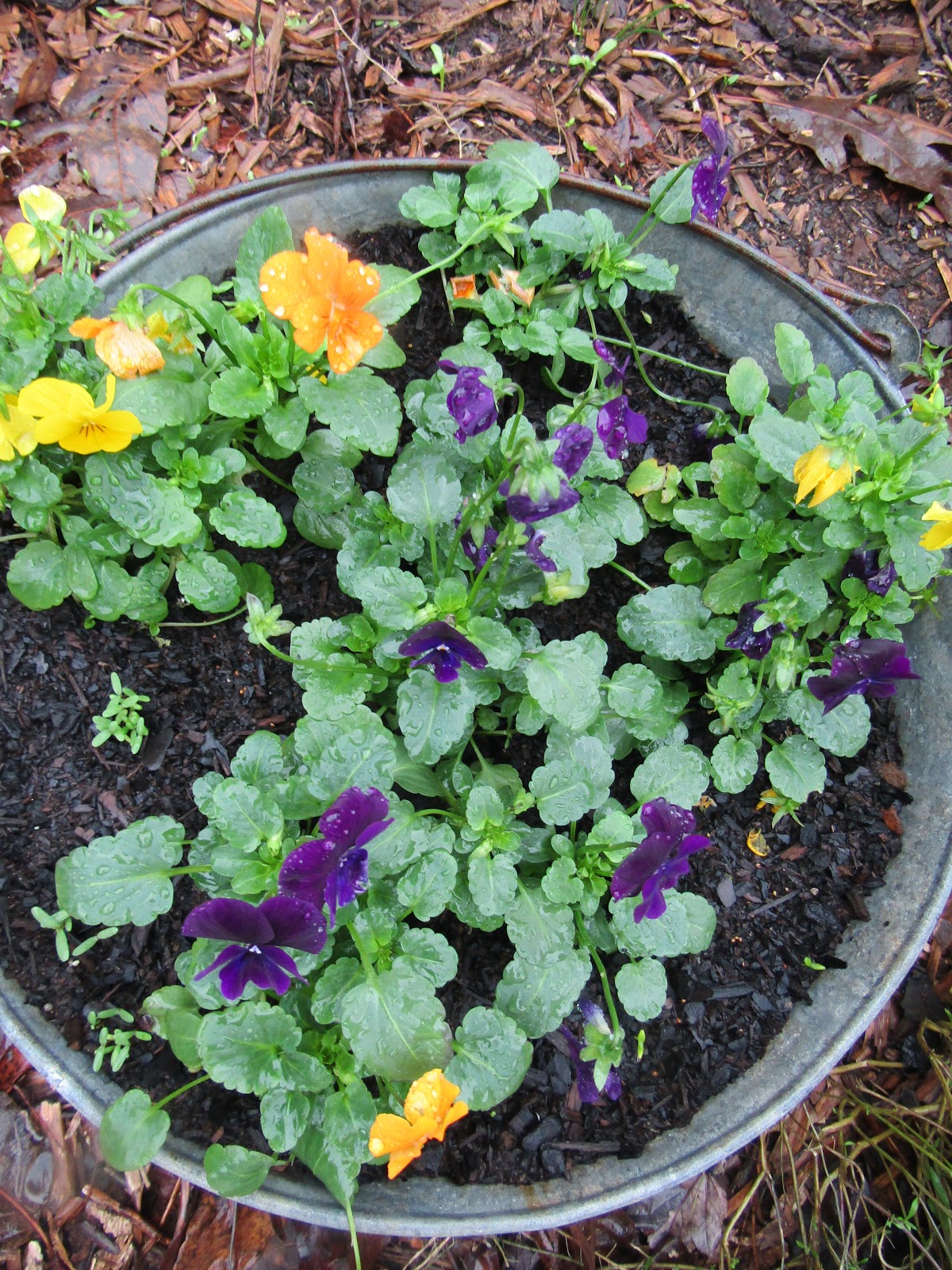
The potted pansies make me smile 
whenever I look out on the front porch.
They are one of the cheeriest flowers I know.
Some alyssum seeds were recently added to the pots.


 Some of the lavender is doing well,
but part of this plant has bowed out.
This plant grouping survived through last winter,
and it will be curious to see how they do this year.
Near freezing overnight temperatures are predicted for this weekend.

lavender blossoms


 The newest raised beds are partly filled with twigs,
although there is a lot more filling in to do
before the soil is added.
With the colder temperatures sneaking up on me,
I'm not sure I'll have time to sow cover crops in these two beds.
Plan B is to continue the hugelkultur method, fill with soil,
and simply dress them with straw.


What a blessing this rain has been!
It saves the gardener time for other endeavors,
like planting, planting, and more planting!

Here's hoping you have just the right amount of rain
in your garden.

Tuesday, October 29, 2019

Community Garden Workday for October (2019)


The morning was cool and cloudy
as we began our efforts at our monthly workday
for the Community Garden in Denver, NC.
There were still a number of beds with goodies yet to harvest.

broccoli

kale

sweet peppers

tomatoes


Doesn't this lettuce look scrumptious?


It looks as if a lot of the okra went unpicked,
but it will still get used.
One of our volunteers is using these mutant pods
to fashion holiday ornaments!


The loofah took its time producing fruit,
(it did the same in my garden),
but it's growing gangbusters now!
Soon they will be harvested so that we
can work on our fundraising project.
Our group creates soap scrubbies with them
and sells them to the public to raise money for the Community Garden.


One of our main focuses on this workday 
was to rebuild a few of our boxes that had deteriorated over time.
A handful of volunteers used saws, rebar and some wood
to save a few of our boxes from disrepair.


The rotted wood was removed,
and using these cement corner pieces,
replaced with new lumber.
The wood boards slide right into the side slots
on these corner blocks.
(I use these in my own garden.)
Hopefully, they will last a good, long time.


Aside from the usual weeding,
we also set out to plant a bed of garlic,
which will be donated to the local food bank.
The cloves were planted 2 inches deep,
about 6 inches apart,
then covered with straw for winter insulation.


We amended the bed with some worm castings
we found in the shed.
It'll be curious to see if it makes a difference.


Our chores are winding down in this garden,
but we look forward to any time spent here.
A dynamic work crew helps the job get done faster.

"Everyone is trying to accomplish something big,
not realizing that life is made up of little things."
~Frank A. Clark

Friday, October 25, 2019

Garden Friday


2019 garlic


It's Garden Friday once again!
The weather has been absolutely stunning,
with much-needed rain helping our parched beds.
The fall garden is underway.


Last weekend, I was able to plant some of our garlic.
These are the heads you see in the first photo.
We had a beautiful harvest in May and used these same heads for planting a new crop.


The largest and most pristine cloves were chosen.
There were only a few cloves that were saved to use for cooking
because they were smaller than what I wanted to plant.
Using the best cloves will ensure a better harvest next summer.


The heads were separated just before planting,
so that they didn't dry out too much.
These are some seriously dense cloves,
originally acquired from Sow True Seed in Asheville.


I decided to use half of the hugelkultur bed to sow the cloves.
Last year, I used one of the 4X4 raised beds,
and it just wasn't enough garlic, so I needed to go BIG!
Using a tape measure, I planted every 4 inches along the row.


This California soft neck variety was planted about 2 inches deep,
making sure that the root end sat on the soil.
It has a mild garlic flavor,
and is perfect for those who say they don't like garlic's pungency.
Garlic is one of the most satisfying crops to grow
because it has virtually no pests, it overwinters easily,
and yields a whole head for each clove planted.
The gifts just keep on a comin'!


Using baling twine, I separated the other two rows that I planted with the same variety,
obtained from another source.
(I waited too long to order more garlic and Sow True sold out.)
All together, I should have almost 40 heads coming up,
so next year, there will plenty to eat, 
and enough to plant in the garden.


The other half of the hugelkultur bed has already been planted
with chard, kale, lettuce and spinach.
When I'm getting ready to sow,
I take the seeds packages out from my storage spot
and place them in this bin,
along with tags I've made myself from plastic water jugs,
and my favorite garden marking pen.
That way, everything's in one place and I can get the job done efficiently.


More spinach, as well as broccoli, cabbage and cauliflower
are the next things to go in.


This garden marker is the best I've ever used.
It doesn't fade, no matter how long it sits outside.


One of the 4X4 raised beds is now filled with seeds.
This is the first time I'm really putting an effort into
creating a design with the plantings.
As the 4 foot width is a bit of a challenge for me,
(I'm on the wee side),
I decided to plant those crops that require less picking in the center,
and things like spinach, which are picked almost daily on the perimeter,
resulting in less reaching across the span.
(All of our new beds are 3 feet across for this reason.)
The nasturtiums are still doing well,
so we'll leave them in place.


The straw bales have been lacking any interest for a good bit.
The holes were filled with good soil and some worm castings.


These bales have already produced cucumbers, flowers, and okra
over the summer.
Now they will host new veggies and some parsley,
which I think will overwinter just fine.
Once we harvest these crops,
the bales will be taken apart to use as mulch
and a new batch of bales will be put in place.


The Egyptian walking onions are slow growing,
but I'll be happy with any I get,
as it's the first time I've grown these.


Leeks have successfully been grown at this time of year,
so I decided to plant a tub's worth.
This is one of my favorite veggies to use for soup.


 Speaking of dining,
someone's been enjoying the sunflower heads left out.


 The lemongrass and aloe vera were watered well,
so that they can be brought into the house for the season.


 The loofah is piling up!

   
It's always so exciting awaiting the seedlings' arrival!
With more rain predicted, 
here's hoping we get to see them before the next Garden Friday!