Friday, April 17, 2020

Garden Friday


Welcome back to Garden Friday!
The garden will soon be full of seeds
and we have a new way to keep them happy!


 This week brought unstable weather.
Once, in the middle of the night, we had three separate tornado warnings.
Scary stuff, but thankfully, we had only minor damage.
It sure wasn't the best day to line-dry clothes!


 In the vegetable garden,
things are slowly coming together.
This is one of the new 3X8 beds
recently planted with Yukon Gold potatoes and onions.


 The potatoes have been popping up sporadically.
More shredded leaves will be added
to top off the bed.


The onions are doing well,
most likely thanks to the 2 1/2 inches of rain we got.
This is my first time growing onions,
and I am so excited to see them doing just fine.


 The other 3X8 bed got weed-wacked this week.
Both of these new beds were sown with cover crop
through the winter.
This second bed will be planted with sweet potato slips
and butternut squash seeds.
While cleaning up the bed, I noticed an abundance of worms.
Something is making them happy down there!


The garlic is looking fabulous,
as only it can.
It will be harvested in a few more weeks.
Although I planted three times as much this year,
it somehow still doesn't seem like enough.
We use it nearly every day.


 A few leek decided to hang around.
I have been waiting for the irrigation project 
to plant most things,
so there isn't much out there.
But that's all about to change...
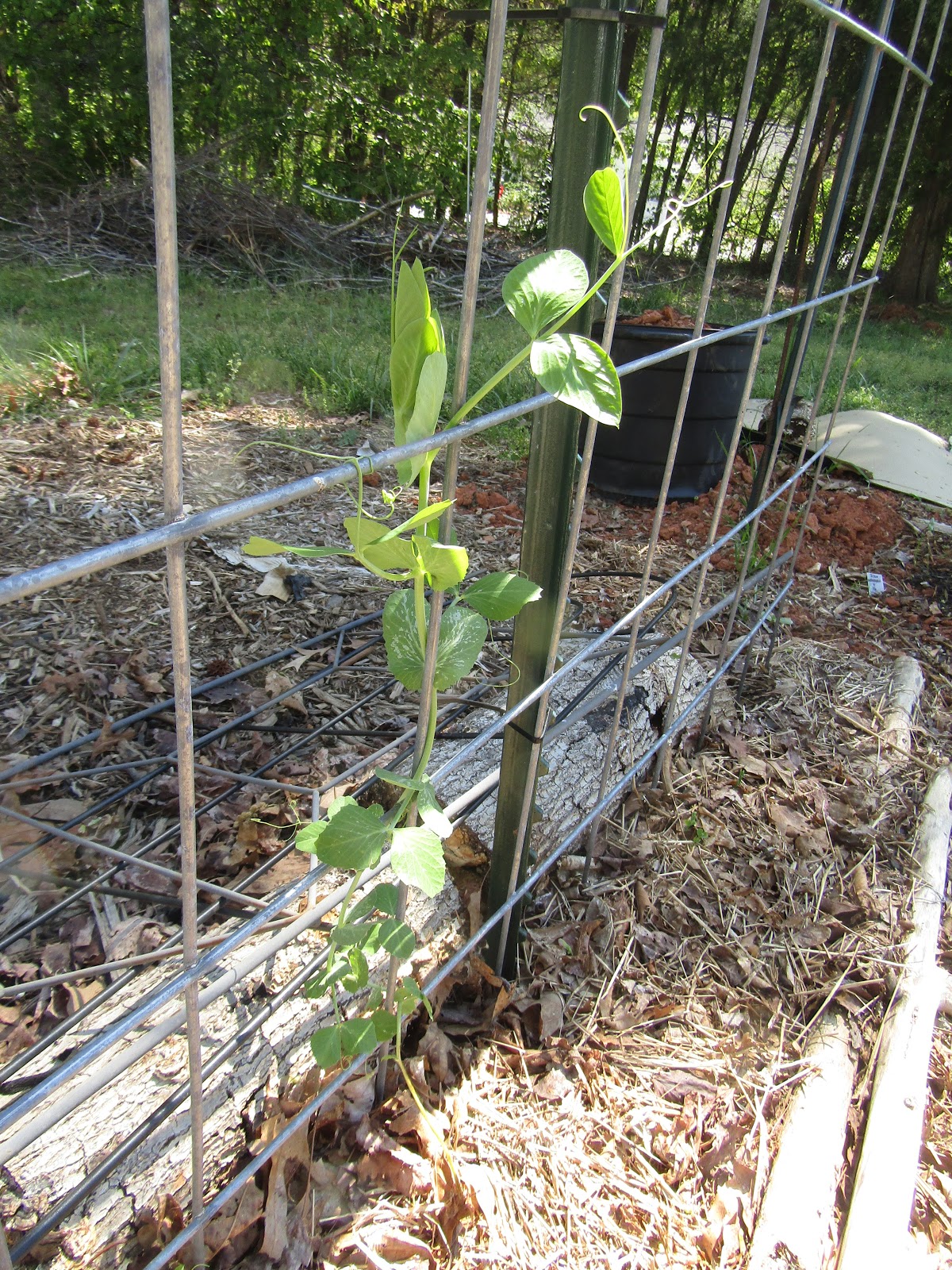

 The peas shot up after the rain,
and I went ahead and sowed them heavily all along
the arches.  I also seeded marigolds here,
to help with pest control.


The strawberries are looking good in their washtub home.
Prepping the surrounding cardboard with soil
is on my to-do list.
Strawberries run, and so as they grow, they give you more plants!


The sunflowers planted in the pollinator bed are growing quickly.
Yesterday I added dianthus, marigolds, and rudbekia to the bed.
This designated flower bed is designed to attract
the pollinators that help to grow our food.
It also adds so much beauty to the garden.


 Everywhere I've planted seeds,
I'm adding some type of wire to deter critters
from digging up the seeds.
This chicken wire will hopefully keep birds and squirrels
away from the row of sunflower seeds planted here
on the outside of the archway.


 A friend let me have this sweet lil' flower stand
and I knew I wanted it spilling over with gorgeous color.
The seeds have been sown,
so it's just a matter of time.
Once the seeds germinate, they can be freed from their bondage!


The best news is...
(may I have a drumroll, please?).
We think we have finally fixed our leaking drip system.
A dry run (no pun intended) was made yesterday,
and it seems that the leaks have been eliminated.
Today we will go through to add a few more elbows
and retest the system before we bury it underneath the mulch.
By the end of the weekend, we should have an efficient
and time-saving irrigation system run on a timer.
Game Changer!


It's been a busy week,
and with the onset of warmer temperatures,
it will most likely get even busier.
But time flies when I'm in the garden,
and the world just kind of fades away.
Every moment is a gift.


Thursday, April 16, 2020

Homemade ACV


Got Heartburn?
Try some Apple Cider Vinegar.
I know it sounds counterintuitive,
but it really does work.
One of the symptoms I was seeing my naturopath about
was a pressure on my sternum,
(right where your ribs meet in the middle).
It wasn't really painful,
and I didn't think it sounded like what folks describe as burning,
but it was extremely uncomfortable.
The only things that gave me any relief were 
burping (excuse me!) or eating.


 She suggested it could be one of two things.
Either I had an ulcer, 
or it was a lack of acid in my stomach,
which made digestion difficult.
We decided to try an ACV challenge.
For a week, I was to take a tablespoon of apple cider vinegar
in a little bit of warm water before every meal.
If it gave me relief, we were on the right track.
If I felt worse, the discomfort was most likely an ulcer
and another course of treatment would be necessary.


I did the "test" and couldn't believe what a difference I felt
in just a few days.
It seems that as we age, our stomach can create less acid,
which helps the food to break down so that it can be digested.
When most people get "heartburn", they take an antacid,
which just exacerbates the situation.
The idea with the ACV is to mimic the natural acid
created by the body.
For me, it worked like a charm,
and I've even decreased the amount I now take.


This simple solution is now even easier
because ACV practically makes itself.
The recipe I used is below.
I hope you'll give it a go,
even if you don't have any digestive issues.
It can be used in place of any standard vinegar
for making salad dressings, household cleaners
or personal care products (like hair rinses).

Homemade Apple Cider Vinegar

2-3 large apples, cubed
1 T organic sugar
water

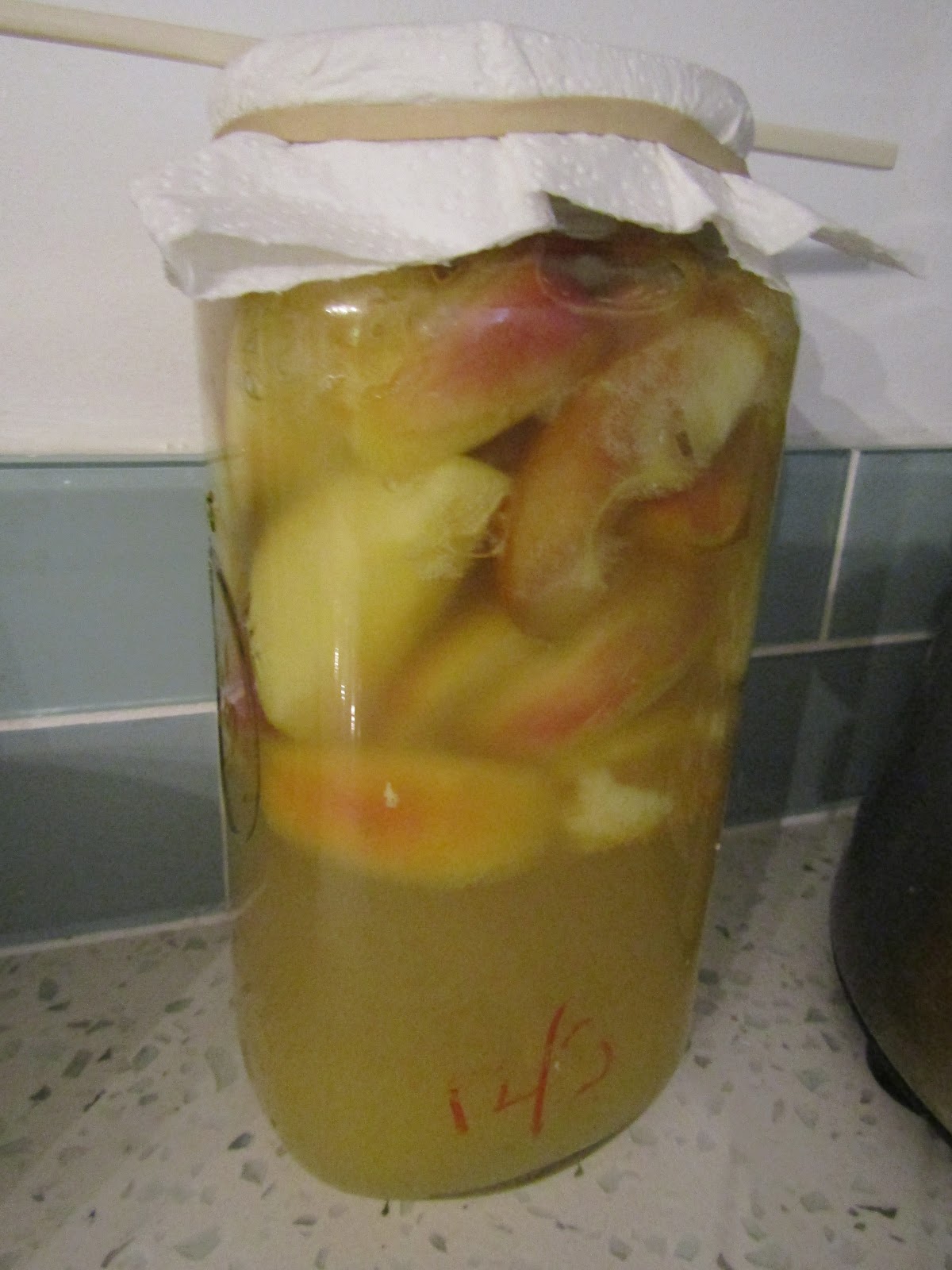
Add apples to a wide-mouth quart jar,
sprinkle with sugar, and fill with enough water
to fully cover apples.
Place cheesecloth (I used a paper towel square)
 over jar and fasten with
rubber band to allow mixture to breathe.
Place in a dark spot for 4 weeks.
After 4 weeks, strain liquid into a clean jar
(discarding apple pieces),
and cover with cheesecloth.
Allow strained liquid to sit in a dark spot
for another 4-6 weeks.
Lastly, seal jar and store in fridge until needed.
Enjoy!

Tuesday, April 14, 2020

Got Fire Ants?


Picnic clip art ants free clipart images 4 - WikiClipArt

It's spring and with so many people sheltering at home,
it's more likely than ever that you may run into 
an encounter with fire ant mounds.
These pesky critters can cause major damage outside,
but have also been known to chew through wires,
creating indoor hazards and loss of electrical power.
We learned how destructive these insects can be
in our Master Gardener class.
Anyone who has been bitten by these insects
is no doubt motivated to be rid of them.

The main goal of eliminating fire ants is to get to the queen.
Without the queen, the colony will perish
because no one will be laying eggs.
To determine if the time is right to apply your fire ant controls,
decide if the ants are active by spreading a few potato chips
in the designated area.
If you return to the spot a few hours later and they are feeding on the chips,
it would be a good time to treat.

Ant House Ant Hill Clipart

The first step of chemical control used in this application
is broadcasting the bait, 
which can be distributed using a hand spreader,
(the kind that is used for spreading grass seed).
This should be done once a year,
until the mounds are no longer visible.
The second step includes drenching the individual mounds
that return to the same area.
Sprinkling the bait around each mound
when conditions are expected to stay dry
should take care of problematic areas.
Here's a video showing the method.


Two methods that have been proposed to work are
hot water and grits.
Neither has been an effective method for managing fire ants.
Unfortunately, I haven't found an effective organic method
for dealing with these creatures.

Library of clip freeuse hot water png files ▻▻▻ Clipart Art 2019
For more information, contact your local Cooperative Extension Center.

 From the NCSU website:
  • "Use fresh bait. Remember that the food portion of the bait must be attractive to the ants. Old bait (particularly past its expiration date) will not attract the ants to feed on it. You can test the bait by putting some out where ants are active and see if they take it.
  • In the spring when ant foraging first starts to increase, you can gauge ant activity by placing pieces of hot dogs or potato chips in areas of known or suspected ant mounds. Watch for ants to start feeding on the food items and then apply the bait as needed. At that point, baiting is likely to be more successful.
  • Apply the bait according to label directions. Sprinkle the recommended amount around each mound (not on top of the mound itself). It is best to apply the bait in the early evening.
  • Many bait labels recommend that the material not be applied within 6 hours after rainfall or heavy dew. Moisture can lead to the bait’s attractant oils becoming rancid and less attractive to foraging ants or may cause the bait granules to lodge in the grass foliage and so the ants do not readily find them."
 Hopefully, this will help you rid  your yard of fire ants,
and enable you to enjoy the great outdoors.

Friday, April 10, 2020

Garden Friday


Happy Birthday to my dear sweet Faye!


Welcome to Garden Friday!
We are continuing to hunker down for the most part,
and enjoying our garden time every chance we get.
Our neighborhood is displaying these red ribbons
outside of our homes as a symbol of unity
through this difficult time.
Our neighbor across the street actually made them
and distributed them at no cost.
We are grateful for good neighbors.


 Last week we transplanted our strawberries
into this big wash tub.
Covering with straw should help to keep them moist,
as they are big drinkers.
The tub is placed on thick cardboard,
so that any runners can sprawl outwards.


The asparagus is amazing me!
Regardless of the poor clay soil,
it is popping out like nobody's business!
As this is the first year it was planted,
it will remain unpicked and left to go to seed.
Next year we should be able to harvest a bit.


The onions planted in one of the new 3X8 beds started emerging this week.
The welded wire will be removed once the Yukon Gold potatoes come up. 
Snap peas were planted heavily 
all along the arches we put up last year.
A few coffee cans were seeded with
lettuce, kale, spinach and chard.


 I'm trying to get a jump start on the sunflowers,
so I planted a few in the pollinator bed,
as well as around the garden.
One of the goals is to feed the birds,
but I'm hoping there is enough seed left after summer's end
to feed me some sunflower sprouts!


 The welded wire covers seem to be deterring any digging,
which is their intended purpose.
Once planting begins in earnest, it should come in handy.
We are still awaiting the correct parts for our drip system.
It's been a lesson in patience, but we hope to wrap it up soon.


 The oregano that was on the property when we bought it,
comes back each year with no prompting from me.
What a delightful gift to us.
I'd like to make more of an effort to dry it,
so that I can stop buying it at the grocery store.


 A few new birdhouses were added to the garden area this week.
I'm thinking, more birds, less bugs in the garden.
We'll see!
A friend also recommended getting a bat house
to help with mosquito control.
I can do that!


 I've always thought that alyssum was an annual,
but it's been coming back on its own.
It's one of my favorite delicate blooms to use as a border,
and I really should use it more in the veggie garden area.
Smells divine too!


The irises are wowing us with drama!
This is the first time since they were transplanted
that they've bloomed.
Worth the wait, wouldn't you agree?


I know I'm a Yankee,
but I love me some dogwood trees!
They compliment the tulips we have coming up
on the west side of our driveway.
Sometimes when I'm walking the property,
I see so many areas that need additions,
but time only allows for so much.
Gardening is always a work in progress.

dogwood blossoms

Here's hoping you have some garden projects
to keep you happily busy at home.
Bee well...